
El petroimperialismo estadounidense en Venezuela
por Sarah Lutz, activista climática senior, y Kate DeAngelis, subdirectora de política económica
Tras meses de amenazas y ataques a barcos venezolanos, el 3 de enero la Administración Trump bombardeó la ciudad de Caracas, matando a un Se estima que 75 personas y el secuestro del presidente venezolano Maduro. La explicación de la administración sobre sus acciones varía según su público, pero en esencia, se trata de un claro imperialismo estadounidense diseñado para consolidar el poder de Trump y enriquecer a sus compinches. Como lo han descrito explícitamente varios... Administración funcionarios, El objetivo es controlar los ingresos petroleros venezolanos y obtener influencia sobre el país. Esta maniobra ilegal de poder ya ha creado oportunidades para que las grandes petroleras exijan concesiones significativas a cambio de su disposición a extraer y lucrarse con los recursos de Venezuela, que incluyen algunos de los yacimientos petrolíferos más grandes del mundo.
A medida que evoluciona la situación en Venezuela, la combinación de la corrupción trumpiana y el enriquecimiento de las grandes petroleras podría hundir al país en una inestabilidad aún mayor. Las grandes petroleras podrían obtener grandes beneficios a costa del clima, de los contribuyentes estadounidenses y del pueblo venezolano.
Devolver el dinero a las refinerías de energía sucia de EE.UU.
La mayor parte de la producción petrolera venezolana es petróleo crudo pesado, que en su punto máximo representa aproximadamente 7% del suministro mundial. Este petróleo pesado requiere un procesamiento especial y, casualmente, las refinerías estadounidenses a lo largo de la Costa del Golfo están diseñadas para procesar crudos más pesados, como los producidos en Venezuela, así como en Canadá, México y Colombia. Estas refinerías, entre las que se incluyen Chevron, Valero, Exxon Mobil, Phillips 66 y Marathon Petroleum, están bien posicionadas para aprovechar las ganancias inesperadas de la presión ejercida por Trump contra Venezuela.
Chevron y Valero son los beneficiarios inmediatos. Chevron es la única gran petrolera que queda en Venezuela operando. bajo una licencia especial[SL1] . Se dice que Valero tiene una acuerdo de compra existente Con Chevron. Estas empresas ya se han beneficiado enormemente del petróleo venezolano, que pueden adquirir a bajo precio y vender con ganancias tras refinarlo.
“Tenemos barriles venezolanos nuevamente en la mezcla, lo que está ayudando.,”, Director de Operaciones de Valero, Gary Simmons dijo a los inversores en octubre. La empresa citado específicamente La pérdida de 200,000 barriles diarios del mercado de la Costa del Golfo, relacionada con las sanciones, representa un obstáculo económico, agravado por la disminución de los volúmenes de exportación de crudo pesado de México. Si Trump levanta las sanciones,... aumentar inmediatamente los márgenes de refinerías en toda la Costa del Golfo.
El director ejecutivo de Phillips 66 no se anduvo con rodeos al hablar en una conferencia de prensa el 6 de enero.el conferencia, en referencia a la intervención de la Administración Trump como una “oportunidad para que Venezuela regrese al redil capitalista.” Citó específicamente el aumento de las exportaciones de Venezuela a los EE. UU. que compiten con el crudo canadiense y mejoran los márgenes de refinación, especulando que sería “constructivo tanto para nuestras capacidades de refinación de la Costa del Golfo, como para nuestras refinerías del Medio Continente”.”
El CEO de Phillips 66 citó además la posibilidad de obtener ganancias por la venta de diluyentes como la nafta a Venezuela, que son subproductos de la refinación y necesarios para procesar el crudo extrapesado del país: “Y, en última instancia, habrá más demanda de nafta. Tenemos oportunidades de exportar C5 [diluyentes] de vuelta a Venezuela si existe esa oportunidad. Y a largo plazo, lo que se ve es potencial de crecimiento. Venezuela producía 3 millones de barriles diarios de crudo pesado..”
Esto fue repetido por Secretario de Energía Wright Al día siguiente, quien declaró: “Vamos a tener esos [diluyentes] fluyendo nuevamente.”Antes de las sanciones estadounidenses, las refinerías de la Costa del Golfo eran una fuente importante de diluyente a Venezuela, vendiéndole al país el producto mismo necesario para transportar el petróleo venezolano de regreso a sus refinerías. Suministros inconsistentes han amenazado con detener las exportaciones de petróleo venezolano y una Hoja informativa del Departamento de Energía Un informe publicado el 7 de enero declaró que Estados Unidos está “reduciendo selectivamente las sanciones para permitir el transporte y la venta de crudo venezolano” y que el diluyente estadounidense fluirá a Venezuela “según sea necesario”.”
Otra refinería que podría beneficiarse es Amber Energy, ganadora de una subasta de Citgo, la refinería estatal venezolana confiscada. Respaldada por El multimillonario Paul Singer, del fondo de cobertura MAGA, La oferta de $5.900 millones fue inferior a la de su competidor más cercano. Esto podría dejar a un aliado político del presidente al mando de dos refinerías en la Costa del Golfo diseñadas para procesar crudo pesado venezolano. Recientemente, Citgo ha tenido que abastecerse de petróleo de fuentes comparativamente más caras, pero estables, como Colombia y Canadá. Si se levantan las sanciones o aumenta la producción, los activos de Citgo en la Costa del Golfo dejarán de depender de este crudo pesado más caro y se beneficiarán nuevamente del crudo venezolano más económico.
Trump se reunió con ejecutivos petroleros en la Casa Blanca el 9 de enero para presionarlos a invertir en la infraestructura petrolera venezolana. Muchos de estos asistentes representaban a empresas que importan cantidades sustanciales de crudo pesado para procesarlo en refinerías a lo largo de la Costa del Golfo y otras partes de Estados Unidos. La siguiente tabla muestra sus importaciones de crudo pesado y agrio:
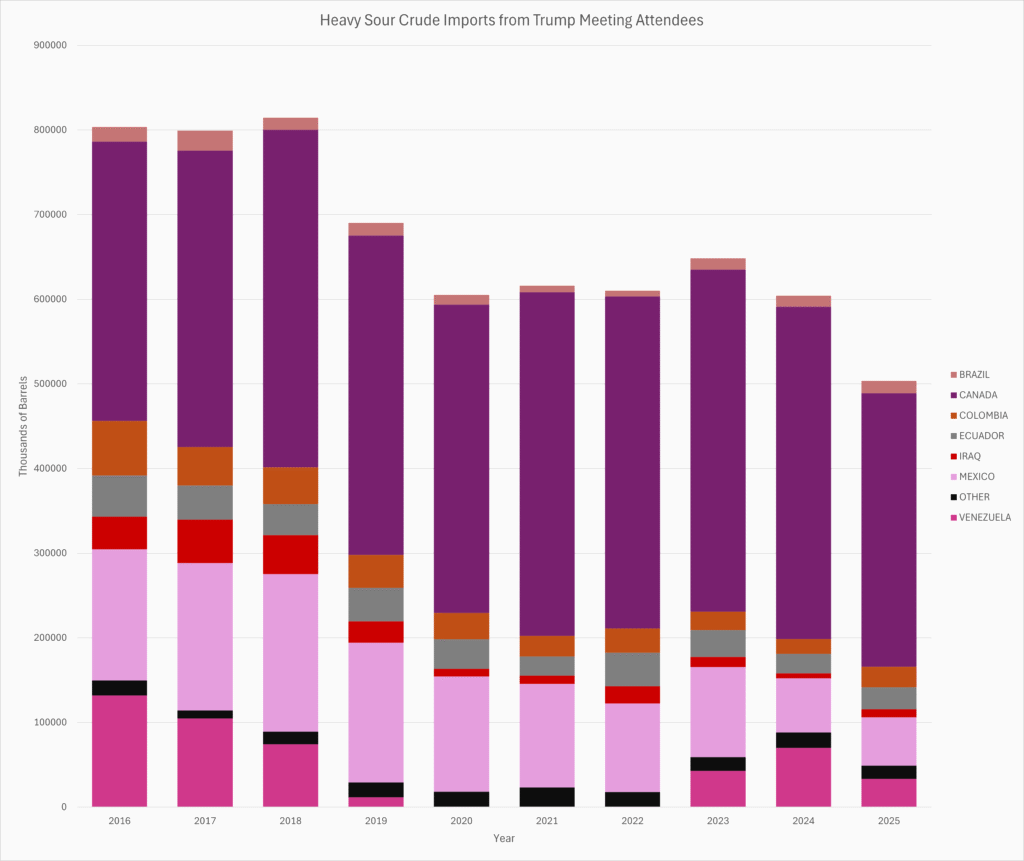
Incluso sin una mayor extracción de petróleo en Venezuela, las refinerías de petróleo pesado se beneficiarán enormemente de la confiscación del petróleo venezolano por parte de Trump. El crudo importado de Venezuela ha sido más barato que sus contrapartes de Canadá y México, y Trump planea aumentar de inmediato... 50 millones de barriles en el mercado y “continuar indefinidamente”. Incluso si el Funcionarios de Trump’Las afirmaciones de que este petróleo se venderá a "precios de mercado" son ciertas, pero aún así habrá un impacto en el mercado a medida que más petróleo venezolano infla la oferta de crudo en los mercados estadounidenses. El precio del crudo canadiense ya ha... abandonó de modo significativo.
Mientras Trump pide que se incremente la extracción de petróleo en Venezuela para desviarlo hacia las refinerías estadounidenses, comunidades En la Costa del Golfo se exige menos. La Costa del Golfo alberga el infame Corredor del Cáncer, un tramo de tierra de 137 kilómetros a lo largo del río Misisipi con una concentración exorbitante de plantas de combustibles fósiles y petroquímicas. cuarto de los productos petroquímicos de los EE. UU. se producen en Cancer Alley, y la contaminación de estas plantas y refinerías ha tenido un alto costo para la salud y el bienestar de las comunidades locales, incluyendo una La tasa de cáncer es más de siete veces superior al promedio nacional.
Atraer a las grandes petroleras de vuelta a Venezuela: riesgo público y beneficio privado
El mayor obstáculo para la inversión masiva de la industria petrolera en Venezuela que busca Trump es la propia industria petrolera. En un momento de superávit en el mercado petrolero mundial, las grandes inversiones en países políticamente riesgosos resultan poco atractivas. Chevron, que nunca abandonó Venezuela, es la que mejor posicionada está entre las grandes petroleras para expandir su presencia allí. Los términos recientes de la autorización de Chevron para importar petróleo venezolano a EE. UU. le prohibían realizar pagos en efectivo al gobierno venezolano, lo que significa que la compañía pagó sus impuestos y regalías en especie (con barriles de petróleo). Esto ha reducido su precio del crudo. capacidad de exportación a aproximadamente la mitad de su extracción en Venezuela.
Especulando antes del derrocamiento de Maduro, los analistas de JP Morgan estimaron que un nuevo régimen en Venezuela podría aumentar la producción a 1,2 millones de barriles diarios al dar vía libre a Chevron y asegurar un suministro estable de diluyentes de crudo importado. Sin embargo, aumentar la producción en medio de la infraestructura obsoleta y deficientemente mantenida del país será costoso. Los analistas de Rystad Proyecto que simplemente mantener la producción actual costaría 1.453.000 millones de dólares durante los próximos 15 años, mientras que aumentar la producción de 1,1 millones a 3 millones de barriles diarios costaría 1.483.000 millones de dólares. Este elevado precio ha hecho que los ejecutivos petroleros duden en comprometerse con grandes inversiones en Venezuela sin importantes concesiones respaldadas por Trump.
La desesperación de Trump por presentar su toma ilegal de poder como una "victoria" otorga a los ejecutivos petroleros una sólida posición de negociación. Fuentes anónimas de la industria petrolera han informado... Lanzó la idea de subsidios para la inversión en Venezuela, incluyendo asociaciones público-privadas, contratos que garanticen ganancias y una garantía para la seguridad física de la inversión. En otras palabras, el enorme costo de expandir la extracción petrolera venezolana podría recaer sobre los contribuyentes estadounidenses. Estas concesiones se sumarían a... $35 mil millones en subsidios federales anuales de los que ya disfruta la industria de combustibles fósiles.
Otros vehículos potenciales para la inversión en combustibles fósiles son los financiadores públicos como el Banco de Exportación e Importación de Estados Unidos (EXIM) y la Corporación Financiera Internacional para el Desarrollo (DFC) de Estados Unidos. Tanto el EXIM como la DFC tienen actualmente prohibido apoyar proyectos en Venezuela. Sin embargo, una interpretación imaginativa de la postura del EXIM... Programa de limitación de países Unas advertencias y una ley del Congreso, respectivamente, podrían abrir estas instituciones para proporcionar miles de millones de dólares a las industrias petrolera y minera de Venezuela.
Es probable que los nuevos líderes del EXIM y la DFC aprovechen la oportunidad de subsidiar la industria petrolera venezolana. El recién confirmado director del EXIM... fijado En noviembre, anunció que planea que el EXIM destine 100 mil millones de dólares a acuerdos de gas, minería y energía nuclear. Ambas agencias han invertido miles de millones de dólares en proyectos de combustibles fósiles durante la última década y han mostrado interés en continuar con este apoyo. Esto significa que al mismo tiempo que la Administración Trump niega fondos para servicios necesarios como cupones de alimentos, cuidado infantil y atención médica, la administración quiere utilizar los fondos de los contribuyentes para permitir que las compañías petroleras obtengan ganancias aún mayores.[SL2]
Recolectando las viejas deudas de las grandes petroleras
La administración Trump podría desempeñar un papel importante a la hora de asegurar las deudas que Conoco y Exxon llevan años intentando cobrar.
Conoco ha ganado más de $10 mil millones En sentencias contra Venezuela que datan de la expropiación de 2007. Analistas de JP Morgan señalan que la compañía recuperó aproximadamente 1.480 millones de tayikos y podría obtener otros 1.300 millones de tayikos por la venta de Citgo ordenada por la corte (véase arriba). Sin embargo, los 1.485 millones de tayikos restantes, provenientes de una sentencia del Centro Internacional de Arreglo de Diferencias Relativas a Inversiones (CIADI) del Banco Mundial, se consideran un mayor desafío para su ejecución.
Según se informa, Exxon Mobil está intentando reclamar aproximadamente $20 mil millones de Venezuela, de los cuales se han pagado aproximadamente 1.400 millones de dólares. Según el New York Times, el CIADI anuló otros 1.400 millones de dólares, pero Exxon ha presentado una nueva demanda para restituir el laudo.
Estas grandes petroleras han estado luchando con el gobierno venezolano en los tribunales durante años, y Trump parece haber tomado su causa al acusar erróneamente a Venezuela de '‘robando nuestro petróleo’' y prometiendo reembolsos a las compañías petroleras. Por su parte, Exxon y Conoco contribuyeron cada una $1 millón al fondo de inauguración de Trump y el director ejecutivo de Conoco, Ryan Lance, ya ha contribuyó con más de $100,000 Desde la reelección de Trump, principalmente a comités políticos del Partido Republicano. Estas donaciones podrían ser insignificantes en comparación con lo que sus empresas podrían recaudar si Trump decide presionar a Venezuela para que pague rápidamente los acuerdos a las grandes petroleras.
Aunque Trump ha sido ambiguo sobre si los fondos estadounidenses respaldarían directamente las inversiones petroleras, y cómo, ha prometido constantemente algún tipo de reembolso por sus "esfuerzos" en Venezuela. Fuentes anónimas de la industria han filtrado que este reembolso desconocido a las compañías petroleras se ofrece, según se informa, como... aprovechar Para alentar a las compañías petroleras a invertir fuertemente en la infraestructura petrolera venezolana. La administración Trump también parece haberse enfriado recientemente ante la idea de forzar el pago de la deuda, con Secretario Wright lo calificó como un “problema a largo plazo” y Trump les dice a los ejecutivos petroleros, “No vamos a mirar lo que la gente perdió en el pasado, porque fue su culpa”. Sin embargo, esta opinión podría cambiar muy rápidamente si las grandes petroleras continúan presionando a Trump para que ofrezca el pago de la deuda como incentivo para regresar a Venezuela.
Trump está desesperado por que las grandes petroleras se sumen a la iniciativa. Mientras intenta intimidarlas para que permanezcan en la mesa de negociaciones, incluso emitiendo una cuestionable... Orden Ejecutiva destinado a impedir que las grandes petroleras soliciten la restitución a través de los tribunales estadounidenses de los ingresos petroleros venezolanos recaudados por Estados Unidos y amenazando con excluir a Exxon Desde Venezuela, después de que su director ejecutivo calificara al país de "imposible de invertir", lo cierto es que las grandes petroleras tienen un inmenso poder para exigir sus condiciones. Esto tiene graves consecuencias tanto para los contribuyentes estadounidenses, que podrían verse obligados a pagar los gastos del dinero público que respalda las ganancias petroleras privadas, como para los venezolanos, que deben asumir las consecuencias mientras Estados Unidos se apodera de los ingresos petroleros del país.
¿Qué significa este petroimperalismo?
Trump, que no es muy sutil, está intentando presentar su versión del petroimperialismo como la "Doctrina Donroe" y ha amenazado [SL3] Para luego centrar su atención en Cuba, Colombia y Groenlandia. Mientras tanto, los funcionarios de Trump se jactan con regocijo de cómo el control estadounidense sobre los ingresos petroleros venezolanos les otorga una inmensa influencia sobre el país.
Pero la administración Trump tiene mucha menos influencia sobre las compañías petroleras, que tienen la libertad de exigir concesiones exorbitantes a cambio de cooperar con los objetivos de Trump. Esto tiene graves consecuencias para quienes sufren este descarado imperialismo estadounidense. En el caso de Venezuela, Los ingresos del petróleo financian más de la mitad del presupuesto del gobierno. Aunque Trump ha dado vagas garantías de que los ingresos petroleros controlados por Estados Unidos se utilizarán para promover la estabilidad en el país, su "plan" no traza una ruta real hacia beneficios tangibles para los venezolanos. Sus objetivos para el país dependen de la extracción estadounidense de los recursos venezolanos, y está dispuesto a utilizar los ingresos que financian el gobierno y la economía de Venezuela como palanca.
Mientras todos los países del planeta enfrentan una emergencia climática y deben eliminar progresivamente y de forma equitativa los combustibles fósiles, de acuerdo con la ciencia y la justicia, la incursión militar estadounidense en Venezuela para obtener su petróleo debe ser condenada. Los venezolanos tienen derecho a la autodeterminación, a la democracia y a tomar sus propias decisiones sobre su país. El petroimperialismo imprudente y peligroso de Trump ha posicionado a las compañías petroleras para obtener grandes beneficios y ha generado consecuencias que pagarán con creces los venezolanos, los estadounidenses y los pueblos de cualquier otro país atacado por Trump.
Publicaciones relacionadas
Formas de apoyar nuestro trabajo

Lea las últimas noticias
Manténgase informado e inspirado. Lea nuestros últimos comunicados de prensa para descubrir cómo estamos contribuyendo al planeta.

Vea nuestro impacto
Vea las verdaderas victorias que su apoyo hizo posibles. Lea sobre los triunfos de campaña por los que hemos luchado y ganado juntos.

Dona hoy
Contribuye a impulsar el cambio. Se necesita el apoyo de defensores del medio ambiente como tú para construir un mundo más sano y justo.