2025
ANNUAL REPORT
championing a more healthy
and just world


Friends,
As we reflect on this past year, our hearts are filled with deep gratitude for your unwavering commitment to championing a healthy and more just world. Every campaign we lead, every community we support, and every environmental victory we celebrate is made possible because of your belief in Friends of the Earth. Thank you for lending your voice, your passion, and your energy to this vital work.
The challenges facing our planet have never been more urgent. Climate disruption, biodiversity loss, and environmental injustice continue to intensify, affecting communities locally and globally. The pressures to address these challenges in a manner that increases racial and economic justice can feel overwhelming, yet it’s these moments of adversity that reveal the extraordinary strength of people who care – people like you, who refuse to stand by in silence.
Organizationally, we are channeling this energy.
With your support, we are filing lawsuits in federal court to stop the Trump administration from harming communities and the environment as they seek to eviscerate our bedrock environmental laws.
We are confronting corporations, private banks, and international financial institutions that are financing deforestation, harmful petrochemical and plastic manufacturing facilities, biodiversity destruction, and large inhumane animal factory farms. If the federal government will not stop these environmentally destructive activities, then corporations must be forced to change.
We are working in states to successfully ban pesticide use that harms pollinators; to expand healthy, climate-friendly meals in schools; and to preserve states’ rights to regulate the use and deployment of artificial intelligence and data centers.
As we look to the year ahead, we ask you to continue standing with us. Together, we can protect our communities, safeguard our climate, and ensure that future generations inherit a healthier, more just world.
Thank you for all you make possible. Your commitment inspires us every day.With gratitude and resolve,


Erich and Jeff

YOU ARE THE SECRET TO OUR SUCCESS!
YOU are the secret to our success!
Since our founding, Friends of the Earth Members have played a key role in helping us get things done in the fight for our planet. After more than half a century, your support, your activism, and your passion for the environment are still fueling our achievements.
The past year has seen many challenges come our way, but because of you and your fellow Members, our dedicated and tenacious coalition of environmental fighters is taking on the most anti-environment administration in U.S. history. And in 2025, with your support, we won key battles for our Earth:
- You helped us protect rare gulf whales, sea turtles, and imperiled marine species from the damaging effects of offshore drilling.
- You helped us fight back against the Trump administration’s dirty energy giveaways.
- You made our Bee-Friendly Retailer Scorecard possible – helping spur Sprouts Farmers Market to adopt a new pollinator health policy to reduce pesticide harms. Sprouts is now the 14th major food or garden retailer to launch a pollinator protection policy.
- You helped us pass Connecticut Senate Bill 9 this past May, restricting the use of bee-killing neonicotinoids (neonics) on all turf in the state. Connecticut is the eighth state to pass neonic restrictions, joining California, New York, Minnesota, Massachusetts, Vermont, Maryland, and New Jersey.
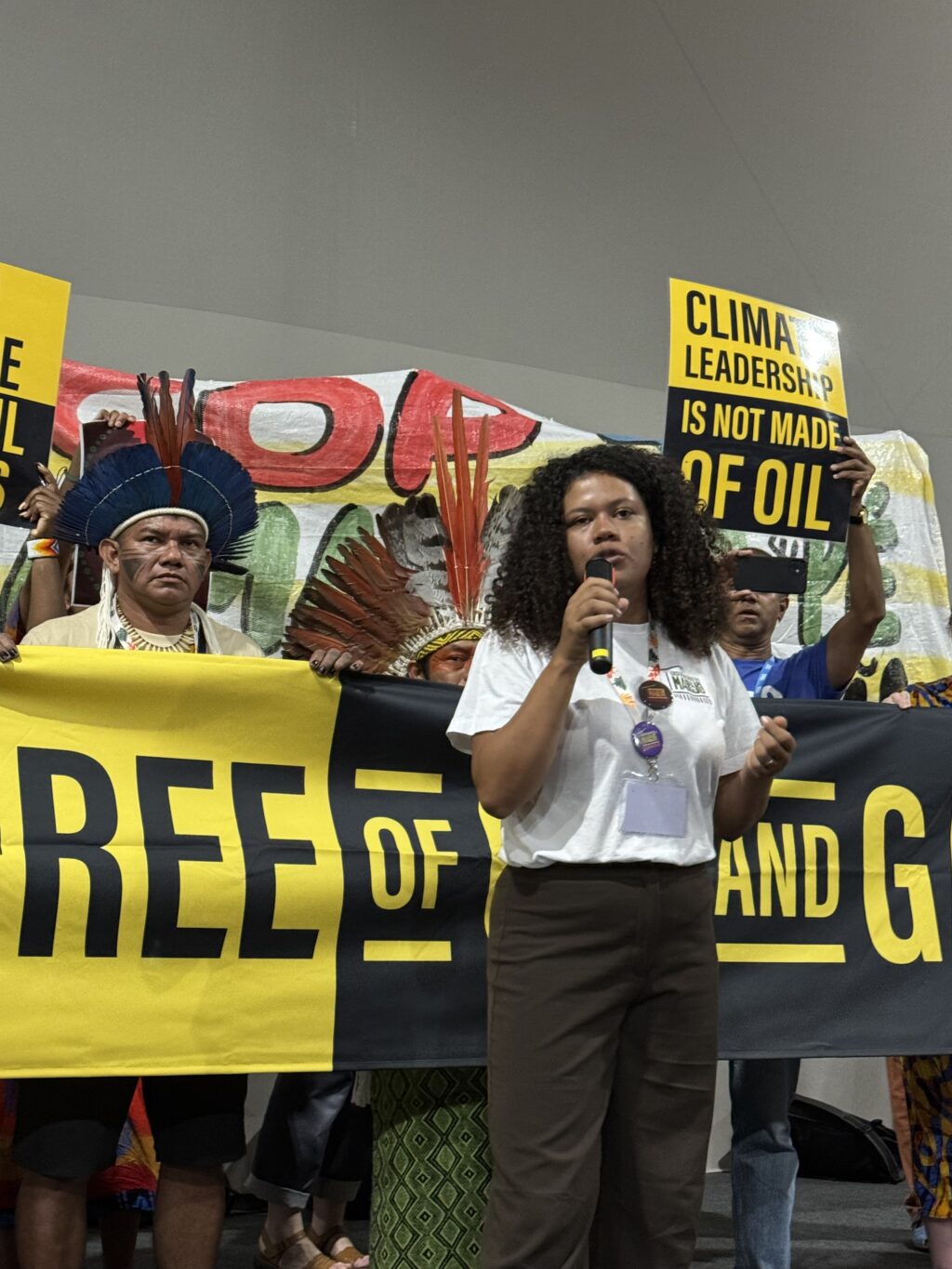
- You helped us expose climate disinformation and secure a historic declaration on information integrity at COP30 in Brazil.
- You helped us advance school nutrition, supporting diversified organic farms and building a more resilient food and agriculture system.
You can read about all these victories and more in our 2025 Annual Report. Please take a moment to celebrate, knowing the difference you’ve made for our planet this year.
And then get ready for 2026 when we’ll ratchet up the pressure on polluters and politicians alike, continuing the work you make possible.
Thank you for standing with us and ensuring that Friends of the Earth can always be a bold and fearless advocate for a healthier and more just world for us all.

5 POINT PLAN
Tackling Trumpism with our five-point plan of resistance
In these extraordinary times, we must act decisively and strategically to protect our planet. Friends of the Earth developed a five-point plan of resistance to ensure that we continue to make progress on our key goals and protect our environment from new attacks.
1. BLOCK Trump’s attacks on people, the planet, and democracy
Friends of the Earth is fighting to protect bedrock environmental policies and laws by defending the institutions, agencies, and norms that help create a healthy planet. We support those who refuse to comply with the Trump agenda and defend those targeted by this malignant administration.
2. BYPASS the federal level wherever possible
As federal action for our planet becomes more difficult, Friends of the Earth is pivoting toward fights at the state and local levels while continuing our federal advocacy when the opportunity arises. We are also working internationally and continuing to secure wins in corporate boardrooms.
3. BREAK and erode Trump’s political power
As part of a broader network, we are undermining Trump’s fragile coalition. The MAGA and Project 2025 agendas are deeply unpopular, making it easier to leverage pressure points and inspire people to join our cause.
4. BRIDGE coalitions with like-minded people
This moment calls on all of us to declare what we stand for, and Friends of the Earth is working across the political spectrum, finding points of agreement and building out campaigns that unite people in broader fights.
3. BUILD the foundation for transformative change
Now is the time for thinking big and advancing inspiring and transformative visions of a positive future for people and the planet. We’re finding new ways to grow progressive, grassroots political power within our campaign work.
All of us at Friends of the Earth believe that this challenging moment can serve as the starting point for positive transformation — for our communities, for our democracy, and for our planet. In 2026, we will continue to be at the forefront of this change, leading us toward a more healthy and just Earth.
Our Commitment to You
We have high rankings with all five charity rating agencies. We value the trust you have placed in our hands, and we believe that you should feel confident about your investment. That’s why we are committed to transparency and accountability.
Thank you again for your generosity and passion for building a healthier and more just world.


CLIMATE
Fighting fossil fuels to protect our climate
With climate chaos accelerating across the globe, Friends of the Earth redoubled our fight against polluting fossil fuels and false climate solutions in 2025.
Saying “no” to dirty energy subsidies
In February, we launched the United to End Polluter Handouts (UTEPH) coalition focused on repealing wasteful fossil fuel subsidies. The coalition released reports exposing the Trump administration’s massive giveaways to the fossil fuel industry.
We also defeated dirty energy giveaways, including decreasing the lifespan of the hydrogen production tax credit; defeating the Renewable Fuel Standard pathway for problematic methane biogas-electricity; and analyzing the GOP’s expansion of the 45Z clean fuel credit, which will provide outsized benefits to the ethanol, soy, carbon capture, and factory farm industries.
Confronting false climate solutions
Marine geoengineering is one of the attempts to remove atmospheric carbon dioxide by increasing ocean alkalinity,, or by dumping iron into surface waters to trigger phytoplankton blooms.
Our Climate team helped lead the charge against marine geoengineering internationally, presenting the dangers of this idea at the London Convention/London Protocol (LC/LP) meeting and at New York Climate Week. Our initiative propelled LC/LP to issue a strong statement outlining efforts to develop a regulatory framework to ban marine geoengineering and to allow carefully vetted scientific research.
We co-authored a report on marine geoengineering, outlining the extraordinary scaling-up marine geoengineering would need to be climate relevant – manipulating 10-20% of the ocean’s surfacefor decades or even centuries; and how the risks would impact ocean basins and coastal community.
We mobilized our Membership to oppose the risky LOC-NESS marine geoengineering proposal to dump over 66,000 gallons of sodium hydroxide – lye – into the ocean near Cape Cod and the Gulf of Maine. Members sent thousands of emails to Woods Hole Oceanographic Institution’s president, department chairs, and the experiment’s lead investigator. Our pressure forced the EPA and project proponents to dramatically shrink the size of the experiment, and to move it away from the traditional waters of the Wampanoag Tribe of Aquinnah.

Fighting climate disinformation
We won a victory for information integrity at COP30 in Brazil, where 13 countries signed the Declaration on Information Integrity on Climate Change. Friends of the Earth supported this work to hold social media platforms accountable in 2025 with our coalition, Climate Action Against Disinformation. We worked on the European Union’s landmark Digital Services Act, which has since levied a fineagainst Elon Musk’s Twitter/X, charging the platform for its deceptive practices.


OCEANS & VESSELS
Fighting for ocean and waterway health
The health of our oceans and waterways is paramount to our efforts to combat climate change and create a healthier and more just planet. In 2025, Friends of the Earth made big strides in ensuring healthier oceans for all.
Preserving the arctic
After years of campaigning, the International Maritime Organization approved the North-East Atlantic Emission Control Area (ECA). Once fully implemented, it will be the largest ECA to date, cutting ships’ emissions of particulate matter, sulfur oxides, and nitrogen oxides across the territorial seas and exclusive economic zones of Greenland, Iceland, and the Faroe Islands.
We pushed the International Maritime Organization (IMO) to grant permanent consultative status to the Inuit Circumpolar Council (ICC). The ICC is the first Indigenous organization to be included at the IMO and represents over 180,000 people across Alaska, Canada, Greenland, and Russia’s Chukotka region.
Protecting the Pacific Northwest
Friends of the Earth worked with Washington state legislators and other partners to successfully introduce legislation requiring cleaner ship fuel use.
In December, the Washington State Board of Pilotage Commission implemented regulations requiring small oil tankers, barges and articulated barges (ATBs) to use a tug escort through a portion of Southern Resident Killer whale critical habitat.

Making ports and waterways cleaner
We worked with national and grassroots organizations to release our first Clean Ports Report Card, grading ports on four categories: Emissions Inventory, Clean Air Planning, Emissions Reduction Actions, and Community Engagement.
Several port regions where we work have secured major EPA Clean Ports Program grants – including the Port of New York and New Jersey, the Maryland Port Administration, the South Carolina Ports Authority, the Port of Wilmington (Delaware), and others. These investments will help modernize port operations and cut diesel pollution by accelerating the transition to cleaner, zero-emission equipment – improving air quality and health outcomes for nearby communities while reducing climate emissions.
Plastics shed microplastics through everyday use, and toxic chemicals are found in our bodies and environments across the globe. Friends of the Earth worked with other environmental organizations to release Exiting Petrochemicals which was endorsed by over 70 organizations. This report demands financial institutions stop funding the expansion of petrochemicals, including plastic production in the United States.


LEGAL
Protecting our planet in court
In 2025, Friends of the Earth’s Legal team used the power of the law to hold polluters and their enablers accountable.
Taking on the Trump administration
We prevailed in our Endangered Species Act lawsuit challenging the Trump administration’s inadequate Biological Opinion on the impacts of offshore oil and gas drilling in the Gulf of Mexico. The federal court ordered the government to strengthen protections for the rare Rice’s whale, sea turtles, and other imperiled marine species from offshore drilling.
Also, a court declared that the federal government relied on faulty environmental analysis for new offshore drilling leases in the Gulf of Mexico. Although we are still waiting for the court to determine the appropriate remedy, we are optimistic that this case is a positive development for our other active litigation over recent fossil fuel giveaways in the Gulf.
We enforced federal open-government requirements, compelling the U.S. Department of State to produce records seeking evidence of suspected bias in its liquefied natural gas (LNG) policy decisions.
We sent the federal government back to the drawing board to revise its analysis of environmental harms from the carbon-intensive Willow Master Development oil-drilling and exploration project in Alaska.
Friends of the Earth and the Center for Biological Diversity sued Trump’s National Marine Fisheries Service and U.S. Coast Guard for failing to analyze how California shipping lane designations harm whales and sea turtles. Ten gray whales were killed by ship strikes in these lanes in 2025. This is our second lawsuit targeting better protection for whales from the risk of ship strikes off California’s coast.
We mobilized our Membership to oppose the risky LOC-NESS marine geoengineering proposal to dump over 66,000 gallons of sodium hydroxide – lye – into the ocean near Cape Cod and the Gulf of Maine. Members sent thousands of emails to Woods Hole Oceanographic Institution’s president, department chairs, and the experiment’s lead investigator. Our pressure forced the EPA and project proponents to dramatically shrink the size of the experiment, and to move it away from the traditional waters of the Wampanoag Tribe of Aquinnah.
Fighting for the planet internationally
Friends of the Earth U.S. joined Friends of the Earth Mozambique in filing a lawsuit challenging the U.S. Export-Import Bank’s (EXIM) approval of almost $5 billion in financing for the Mozambique Liquid Natural Gas project. The project has already displaced thousands of locals, been the site of alleged human rights violations, and will cause significant environmental destruction if completed. What’s more, the EXIM board was filled by President Trump without legally required Senate consent.
With Members like you standing at our side, Friends of the Earth will spend 2026 continuing to hold polluters and the government accountable for the harm they cause to people and the planet.


AGRICULTURE
Transforming our agriculture system
Factory farming is harming public health, worker safety, local economies, animal welfare, and clean air and water. In 2025, Friends of the Earth worked to shift away from this polluting, unjust and inhumane system toward a food system that is healthy for people, the planet and animals.
Improving school food
Our Climate Friendly Food Program helped more than 100 school districts increase offerings of organic and plant-based school meals. By working directly with school districts and USDA Department of Defense (DoD) Fresh Program vendors, we’ve helped 466 California school districts purchase nearly $6 million in organic produce – $3.5 million in 2024–25 alone. There are now 35 organic items seasonally available to more than 2 million students through this program, which in turn, supports the livelihoods of dozens of organic farmers.
Advocating for animals and public health
We organized a sign-on letter and built a new coalition of more than 50 organizations urging the U.S. Food and Drug Administration to ban ractopamine, a chemical substance fed to factory farmed animals to rapidly increase their weight that poses risks to animal and human health. Our collective petition drive has generated more than 80,000 signatures and will be delivered to the FDA in the coming months.
Throughout 2025, the media has covered our manure biogas research to show that factory farm gas is an ineffective climate solution. In Maryland, we helped defeat a bill to incentivize manure biogas through state procurement. At the federal level, the U.S. Department of Agriculture paused issuing loans on digesters following a petition we helped file with the agency making the case to stop funding factory farm gas through its renewable energy grant and loan program.

Confronting global industrial agriculture
After four years of sustained community advocacy with support from Friends of the Earth, the InterAmerican Development Bank (IDB) Invest accountability mechanism (MICI) confirmed 7 serious policy violations linked to their harmful 2021 loan to Pronaca, a giant meat corporation in Ecuador. The decision marked a rare and significant accountability milestone for communities affected by IDB-financed industrial livestock projects.
Meanwhile, we expanded our support for the global Stop Financing Factory Farming campaign and helped propel the International Financing Corporation (IFC) to significantly reduce factory farming investments. And we organized a Global Day of Action across five continents and 12 cities calling on the World Bank Group to stop financing factory farming.
With help from our Members, Friends of the Earth will continue the fight to transform our agriculture system in 2026, ensuring it produces food that is healthy for people and the planet.


SOUTHEAST
Organizing against dirty energy in the Southeast
Our Southeast team spent 2025 working hard to stop dirty energy in North Carolina, and together with allies and residents we achieved several key victories.
Fighting for environmental justice
Our Southeast team consulted with the North Carolina Department of Environmental Quality and worked with the North Carolina Environmental Justice cohort on Solar for All’s community engagement plan. Friends of the Earth played a key role in helping design and launch a community advisory board and served as an environmental justice advisor for Governor Josh Stein’s administration.
Rallying communities against pollution
In St. Pauls, North Carolina, we helped organize residents in opposition to the proposed expansion of the Robeson County regional landfill – a facility that is already leaking PFAS (so-called ‘forever chemicals’) into ground and surface water, household wells, a nearby swamp, and the countywide water system.
St. Pauls residents packed the county commissioner meeting in August and turned in 500 signatures on a petition to halt landfill expansion plans, to stop taking waste from Fayetteville Works (a PFAS source from Chemours and Dupont Corporations), and to close the wastewater treatment plant in St. Pauls.
Pushing for clean energy
Friends of the Earth co-founded the Southeast Coalition for Clean Energy (SECCE), which is organizing with communities across eastern North Carolina to oppose a “pilot program” that would turn industrial animal-waste methane into energy.
Started and run by Piedmont Natural Gas, a wholly owned Duke Energy company, the program would collect methane from sources such as hog and poultry factory farms and landfills and sell it to customers as fuel. Community members and advocates warn the project would worsen local pollution, harm nearby residents, and lock in fossil-fuel infrastructure – slowing North Carolina’s transition to truly clean energy. Friends of the Earth is working with SECCE and local partners to stop the program.
In 2026, with help from our Members, Friends of the Earth will continue empowering residents of the Southeast to confront polluters and push for the protections they want for their communities.


POLLINATORS & PESTICIDES
Protecting pollinators from pesticides
Our Pollinators and Pesticides team continued to make progress against pollinator-toxic pesticides in 2025, racking up big wins in state legislatures, corporate boardrooms, and public awareness.
Winning at the state level
Friends of the Earth helped win passage of Connecticut Senate Bill 9 in May, a major step forward for pollinator protection. The new law bans the use of bee-killing neonicotinoid pesticides (“neonics”) on turf statewide – helping ensure that an estimated 500,000 acres of state land will remain neonic-free. Connecticut now joins a growing group of states taking action to curb these harmful pesticides, including California, New York, Minnesota, Massachusetts, Maryland, Vermont, and New Jersey.
Confronting corporate pesticide pollution
As a result of our Bee-Friendly Retailer Scorecard campaign, Sprouts Farmers Market became the latest company to establish a pollinator health policy addressing pesticides, joining 12 other companies listed on the Scorecard that have adopted their own policies.
We held a week of action zeroing in on Target, mobilizing hundreds of people to call or email the company and urge it to do more to protect pollinators. Our campaign also included a LinkedIn ad campaign that reached 149,000 accounts, 84% of which were employees of Target, including many senior company leaders.
To add pressure on the company to do more to eliminate pollinator-toxic pesticides from its supply chain, we released a study finding 29 pesticides in Target’s house brand baby food, including 10 pesticides banned in the EU.
Focusing on farming
We released our new report, Rethinking No-Till, highlighting the ways pesticide corporations are greenwashing “regenerative agriculture” to prop up chemical-intensive farming.
Sounding the alarm on risky new biopesticides
Friends of the Earth led a California coalition to ensure that a new generation of genetically engineered biopesticides will be subject to statewide rules and rigorous risk assessments so these products won’t be deployed without clear, science-based safeguards for pollinators and ecosystems.
In October, we participated in the International Union for the Conservation of Nature (IUCN) 2025 Congress, co-sponsoring an IUCN resolution for a moratorium on genetic engineering of wild species and working on resolutions related to releasing genetically engineered animals into the wild. This resolution aims to protect native species and fragile ecosystems.


ECONOMICS & FORESTS
Disrupting the financing of forest destruction
Worldwide, banks are major players in forest destruction through international finance projects. Friends of the Earth’s Finance and Econ team tackled this system in myriad ways in 2025 to protect biodiverse forests, the rights of Indigenous Peoples and forest communities, and our planet.
Pushing banks toward biodiversity
As part of the steering committee of the Banks and Biodiversity Initiative, Friends of the Earth is leading academics and civil society and peoples’ groups’ efforts to hold banks accountable for their impacts on biodiversity and critical ecosystems, including the call for banks to adopt our proposed No Go areas.
Our advocacy and collective efforts led to the adoption of some No Go areas by the Asian Development Bank (ADB) and European Bank for Reconstruction and Development (EBRD) in 2025. The ADB strengthened its requirements for free, prior, informed consent. We are co-leading the civil society working group that is engaging the International Finance Corporation, to incorporate critical biodiversity protections in its forthcoming, updated Performance Standards.
Confronting international finance
Our team worked closely with members of the House Foreign Affairs Committee, persuading Democrats to vote unanimously in favor of our suggested measures regarding the U.S. International Development Finance Corporation’s (DFC) reauthorization. Though the amendment failed, we successfully convinced Democrats to vote for strengthening transparency, accountability, and safeguards for the DFC.
Meanwhile, our research revealed that overseas fossil fuel financing decreased by up to 78% in 2024 — a drop of between $11.3 billion and $16.3 billion.

Preserving forests and the rights of forest-dwelling people
In collaboration with Brazilian partners, we published new research showing that financial speculation is a leading driver of environmental degradation in Brazil’s fragile Cerrado region. We delivered the research to community leaders and lawmakers to support rural communities’ claims to land in the face of foreign financial interests.
After driving numerous consumer brands to cut ties with an abusive palm oil company in Sulawesi, Indonesia, our advocacy support for local villagers has led to several land claims being resolved, with many more in progress.
When the Roundtable on Sustainable Palm Oil announced it would reverse a decision to require one of its company members to restore over 2,500 acres of destroyed Liberian forest, we launched a pressure campaign to prevent backsliding and to protect the rights of Liberian forest communities.

FINANCES
| REVENUE | Without Donor Restrictions | With Donor Restrictions | Total |
| Grants, Bequests & Contributions | $10,651,687 | $8,878,292 | $19,529,979 |
| Other Income | $1,266,363 | $11,002 | $1,277,365 |
| Net Assets Released from Restrictions | $7,564,439 | ($7,564,439) | |
| TOTAL | $19,482,489 | $1,324,855 | $20,807,344 |
| EXPENSES | |||
| PROGRAM EXPENSES | |||
| Economic Policy | $1,933,051 | $— | $1,933,051 |
| Oceans & Vessels | $1,534,257 | $— | $1,534,257 |
| Climate & Energy | $1,676,381 | $— | $1,676,381 |
| Food & Agriculture | $3,482,993 | $— | $3,482,993 |
| Outreach, Communications, DEIJ & NC Restricted | $5,130,336 | $— | $5,130,336 |
| Membership | $1,533,809 | $— | $1,533,809 |
| TOTAL PROGRAM EXPENSES | $15,310,827 | $— | $15,310,827 |
| SUPPORTING EXPENSES | |||
| Management & General | $1,112,938 | $— | $1,112,938 |
| Fundraising | $1,851,618 | $— | $1,851,618 |
| TOTAL SUPPORTING EXPENSES | $2,964,556 | $— | $2,964,556 |
| TOTAL EXPENSES | $18,275,383 | $18,275,383 |
| NET ASSETS | |||
| Net Assets – Beginning of Year | $11,913,575 | $5,143,321 | $17,056,896 |
| Change in Net Assets | ($1,207,106) | $1,324,855 | $2,531,961 |
| NET ASSETS – END OF YEAR | $13,120,681 | $6,468,176 | $19,588,857 |
| ASSETS | |||
| Cash and Cash Equivalents | $9,202,980 | ||
| Grants Receivable | $2,266,120 | ||
| Accounts Receivable | $56,301 | ||
| Right of Use Asset | $1,055,639 | ||
| Prepaid Expense and Other Assets | $383,159 | ||
| Fixed Assets, Net of Depreciation | $498,414 | ||
| OTHER ASSETS | |||
| Investments | $9,042,920 | ||
| TOTAL ASSETS | $24,066,652 |
| LIABILITIES | |||
| Accounts Payable and Accrued Expenses | $1,619,584 | ||
| Lease-related Liabilities | $3,644,667 | ||
| Charitable Gift Annuities Liability | $40,743 | ||
| Loan Payable | $40,743 | ||
| TOTAL LIABILITIES | $5,447,428 |
| NET ASSETS | |
| Unrestricted | $13,120,681 |
| Restricted | $6,468,176 |
| TOTAL NET ASSETS | $19,588,857 |
| TOTAL LIABILITIES AND NET ASSETS | $24,066,652 |