

Regenerative Food Labels: What’s Behind the Claim?

Not All “Regenerative” Labels Are Created Equal
A growing number of food labels claim to verify that foods are regeneratively grown. But with no widely accepted definition of regenerative agriculture, and each label offering its own interpretation of what qualifies, what do these labels really mean?
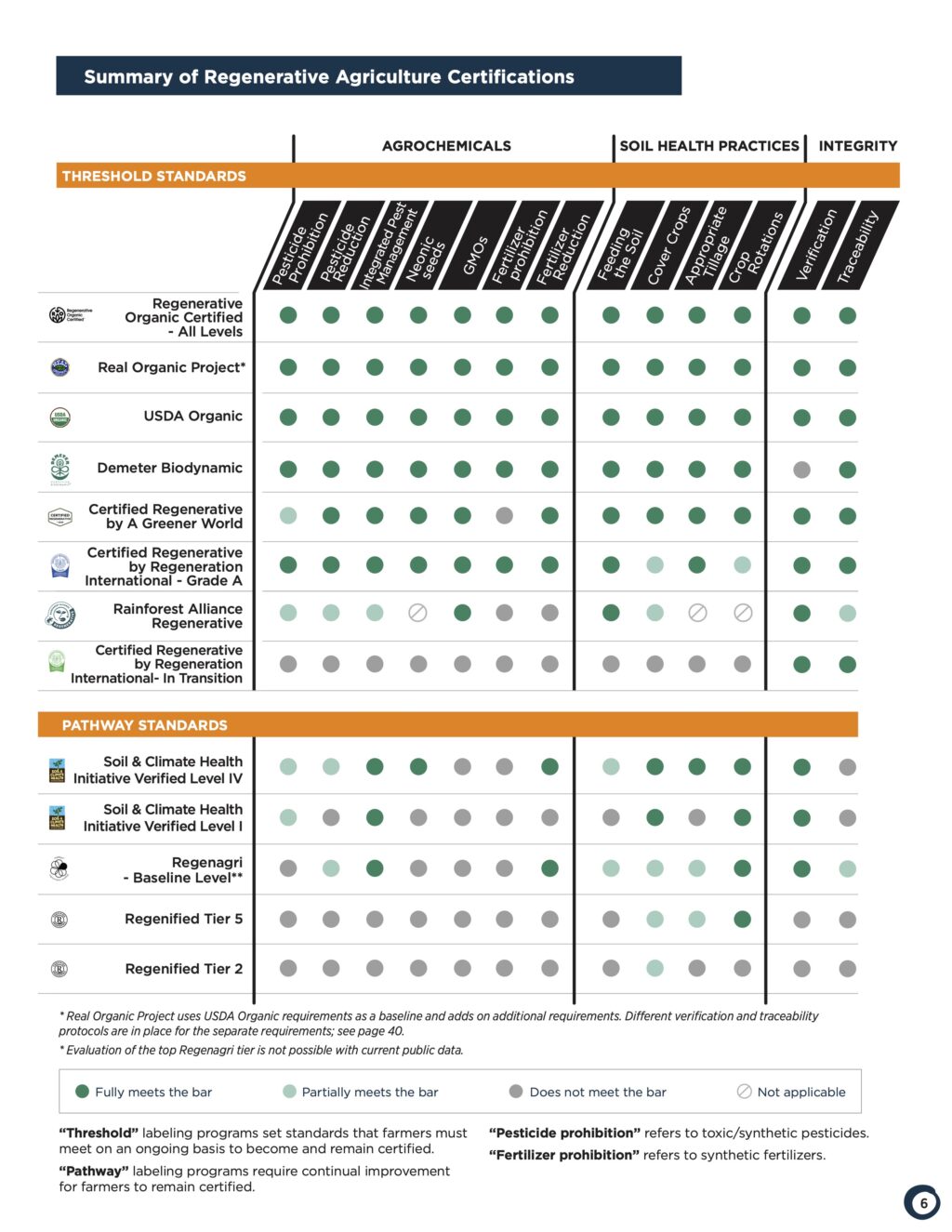
To help consumers navigate this crowded landscape, we evaluated how ten labeling programs stack up in terms of phasing out harmful pesticides and synthetic fertilizers, building soil health, verifying farmer practices, and tracking products from farm to shelf.
We found that regenerative labeling programs vary dramatically in what they require — and some of the most rigorous standards meeting regenerative principles don’t use the term at all.
Importantly, while many consumers reasonably assume that “regenerative” food is grown without toxic pesticides, that’s not always the case.
Read the full guide
Read the press release
Key Findings
“Regenerative” lacks a common definition: There is no universally accepted standard for regenerative agriculture, resulting in a wide range of labels with differing meanings and requirements on agrochemical use and soil health practices.
Label credibility varies widely: Labels are only as trustworthy as their enforcement. Programs differ significantly in how they verify farmer compliance and track products from the farm to the final product consumers see on the shelf. The verification and traceability requirements of standards range from robust to nearly meaningless.
Some regenerative labels allow toxic pesticides: Some standards allow the use of synthetic pesticides, including substances linked to health problems — including cancer, hormone disruption, infertility, and neurological harm — as well as environmental problems, including degradation of soil ecosystems and decimation of pollinators.
Soil health requires both practices and agrochemical restrictions: The most credible programs combine active soil-building practices (like cover cropping and crop rotation) with limits on harmful pesticides and synthetic fertilizers.
Different labeling programs serve different purposes: Some programs set a high bar and offer stronger assurances about final products. Others meet farmers at the beginning of their regenerative journey and support gradual improvement but may provide less clarity for consumers about what a label guarantees.
USDA Organic and labels built on it stand out: USDA Organic, and labels that build on it — Regenerative Organic Certified and Real Organic Project — remains the most reliable and enforceable standard when it comes to chemical use and soil health. The organic standard prohibits all synthetic fertilizers, more than 900 synthetic pesticides otherwise allowed in farming, and has strong requirements for ecological soil health practices combined with a robust verification system backed by federal law.
Labels are filling gaps left by public policy: The growth of regenerative labels reflects shortcomings in current agricultural policies, which continue to favor industrial, chemical-intensive farming systems rather than supporting regenerative practices at scale.
A future where strong standards are the norm is possible: The report envisions a food system where the highest standards represented by today’s leading labels become the baseline — supported by public policy and widely adopted across agriculture.
Scope of Our Analysis
Six of the labeling programs we evaluated specifically use the term regenerative or a variant of it. We also evaluated four labeling programs that address regenerative farming principles without specifically claiming to be regenerative labels.
Consumers and purchasers like food companies, schools, and hospitals may choose foods with regenerative labels for a range of reasons. Some consumers may be motivated by personal outcomes – for example, reducing dietary exposure to pesticides is a key concern for many. Consumers or purchasers may have a desire to support farming systems that regenerate soil, ecosystems, and communities. Companies may be seeking to meet supply chain targets around supply chain sustainability and resilience. With these different motivations in mind, we focused on three scopes of analysis:
Agrochemical Use
Toxic pesticides and synthetic fertilizers cause devastating harm to biodiversity, the climate, and human health. Derived from fossil fuels and manufactured in energy-intensive processes, toxic pesticides ravage the soil microbiome and pollinator communities. Decades of research also links the pesticides widely used in conventional agriculture to cancer, infertility, hormone disruption, and other health harms. Farmers, farmworkers, and rural communities are on the frontlines of exposure, while pregnant people and children are the most vulnerable to the harms of exposure. Transitioning away from these harmful agrochemicals is one of the most urgent issues facing our food system, and essential if we are going to achieve true regeneration. For each program, we examine synthetic fertilizer and pesticide restrictions and prohibitions, as well as five key Integrated Pest Management (IPM) principles. IPM is an ecological approach to pest control that emphasizes strategies to minimize chemical pesticide use.
Soil Health
Soil is the foundation of our food system. Building soil health is a core pillar of regenerative agriculture, and it is intertwined with reducing agrochemical use. Phasing out the chemicals that ravage the soil microbiome can repair and restore soils; soil health practices like cover cropping and crop rotations can break pest and disease cycles and therefore reduce dependence on chemicals. For each labeling program, we assess whether they include strong, enforceable standards on four soil health practices essential for ecological farming systems: feeding the soil through natural sources of fertility, cover cropping, appropriate tillage, and diversity through crop rotations.
Standard Integrity
A regenerative labeling program is only as strong as its verification system. A label’s credibility depends not only on the rigor of its standards for practices that occur on certified farms, but on how those standards are verified. We evaluate each of the ten labeling programs on their verification mechanism, with independent third-party verification recognized as the strongest model. We also evaluate their traceability and segregation requirements, which ensure that certified products can be traced from the farm to the consumer’s fork.
Threshold vs. Pathway Programs
We divided the labeling programs into two categories: threshold programs and pathway programs. We did this because the two types of programs meaningfully differ in their stated goals and structures, and we wanted consumers and purchasers to compare within as well as across categories.
We define “pathway” programs as those that require continual improvement for farmers to remain certified. This can look like a timebound requirement to move up a tiered framework or improve an overall score based on on-farm practices. The programs that fall into this category are Regenified, Soil & Climate Health Verified, and Regenagri. Most of these programs place an emphasis on “meeting farmers where they are,” and one of their strengths is that they do the important work of reaching farmers at the beginning of their regenerative journey and supporting them as they make incremental improvements. One of the challenges with these programs is that they use the same consumer-facing label regardless of what level, tier, or score a farmer has achieved. This risks consumer confusion and limits the assurances that these programs can provide consumers about the attributes of final labeled products.
The other seven labeling programs we evaluate set a single “threshold” that farmers must meet on an ongoing basis to become and remain certified. In most cases, this bar is higher than the entry-level requirements for the pathway frameworks, representing many enforceable and verifiable requirements related to agrochemicals, soil health, ecological management, and other regenerative principles. While this means that the threshold programs may not be as broadly accessible for farmers as the pathway programs, it also means that they can provide strong assurances for consumers and purchasers about practices being implemented on-farm and the nature of the final labeled product.
Regardless of whether a program takes a threshold or pathway approach, the strongest programs pair meaningful chemical use and soil health standards with robust verification, strong traceability requirements, and transparency.
Other Pillars of Regenerative Agriculture
Outside the core scope of our analysis, we also assessed three other pillars of regenerative agriculture—whether the label includes criteria related to 1) deforestation and conversion of native ecosystems, 2) animal welfare, and 3) social fairness, including farmworker rights and protections.
Ways to Support Our Work

Read Latest News
Stay informed and inspired. Read our latest press releases to see how we’re making a difference for the planet.

See Our Impact
See the real wins your support made possible. Read about the campaign wins we’ve fought for and won together.

Donate Today
Help power change. It takes support from environmental champions like you to build a more healthy and just world.